I decided to look at Rhythm of Food. The project sources include food-related search items, including ingredients and recipes. They started with the data from FooDB. They also had Google search data from data trends. It looks like they processed the data in Tableau or some other data-processing software. I tried to find the exact data processing software they used. As for the presentation, they decided on a website format that they shaped the interactions of by using JavaScript. They used different supports for javascript, specifically ES2015, webpack, react, Material UI, and d3 v4. The way the website is set up provides more broad information into more specific information, then back to general information. In the particular information sections, they provide data visualization on a clock of the months with a little explanation to the side. Once clicked, that opens up another chart that shows the years. However, they also provide a play animation on the clock to go through the years and in relation to the months.
This project is in conversation with sociology and anthropology. There is a lot to say about what humans are looking for in each society and at what times. Someone in Canada is less likely to look up dragon fruit than someone in South America or Asia. Thus, the target audience can be as broad as the average person who is interested in trends to the person taking the anthropology of food to the anthropologist looking at how food is trending to comment on society.
All of this leads me to a couple of questions. First, what are the data processing tools they used? Second, would this project show more interesting trends if it were to branch off into looking at words that followed or preceded the food word? Lastly, was there a more effective format than the wheel of the year?
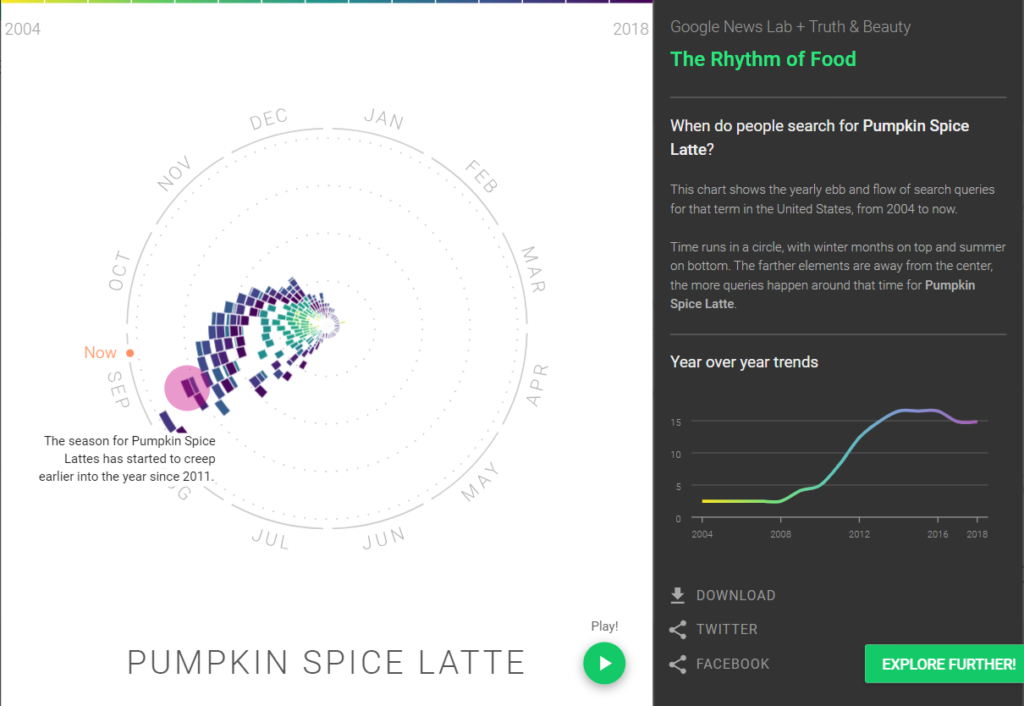
Sources: Rhythm-of-food.net and truth-and-beauty.net.

I like how you connected this digital humanities project to sociology and anthropology. Most of the projects I looked at had to do with history, so it’s cool to see one that has to do with a different field of humanities. Your description of the website, its functions, and how they built it is also very well done. I struggled to figure out how the project I chose was constructed, so I’m happy you were able to figure yours out. I definitely want to check out this project now!
I myself did created a blog post about the rhythm of food but this statement made “Someone in Canada is less likely to look up dragon fruit than someone in South America or Asia” I genuinely didn’t realize the connection anthropologically and sociologically. I wonder if analyzing the words preceding or following food terms could reveal even deeper cultural insights