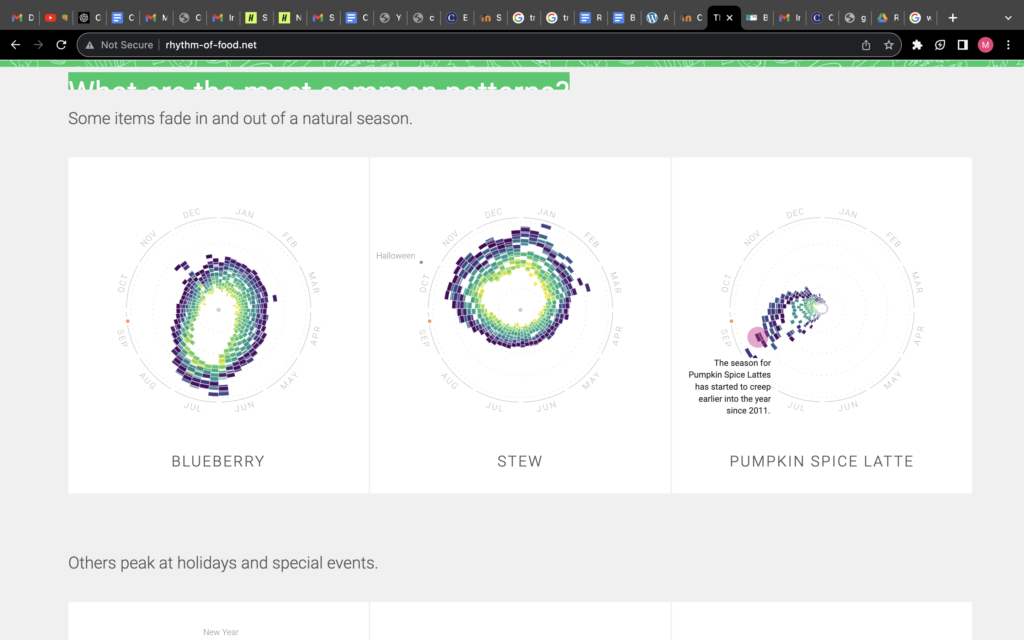
The project I explored was titled The Rhythm of Food. It primarily focused on Google search interests in foods, and what seasonal patterns these search interests revealed. The sources for this project were Google searches of different foods/beverages. The processes of this project consisted of comparing Google search trends and their relative popularity during different months, and to a greater extent, different years. The data was presented in radial year clock charts that had each data point in a corresponding color that denoted the year the data was collected.
Additionally, the charts displayed the month that the data was collected to show potential seasonal trends over time, and each data point indicated its search popularity by having a Google trends score. The higher the score, the greater the search popularity. After viewing this project, I was curious as to whether Google food search trends are indicative of the general population’s demand for foods, or whether is there a difference between the seasonal food preferences of people who have access to the internet, as opposed to those who do not. The goal of this project was to determine how people search for food, and what trends can be found by examining the frequency of food searches at different times in the year, over a time frame of multiple years. I think this project fits under the academic field of data science because this project uses massive amounts of unstructured data. Furthermore, this project takes in this massive raw data and structures it in a way that demonstrates seasonal trends in the popularity of different food searches.

I found it quite fascinating how a handful student happened to explore and delve into the rhythm of food (myself included). Regarding your post, The use of massive amounts of unstructured data and the creation of radial year clock charts to visualize the trends is both creative and analytical. I’m curious to know if their research also took into consideration cultural or regional variations in food search trends. Did you notice any significant differences in search patterns among people from various parts of the world, or was the focus primarily on broader seasonal trends?