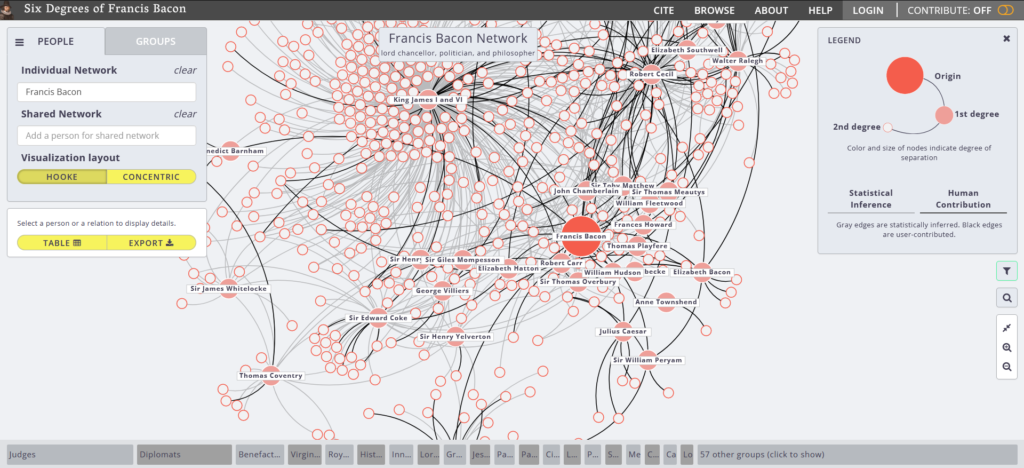
The Network analysis project I chose to focus son was 6 degrees of Francis Bacon. Francs Bacon was a famous philosopher most well known for his creation of the scientific nation.. The Nodes are people living in a similar time period that have at least a slight degree of notoriety. The edges are relations between people. So if two nodes are connected that means they have a relationship. One node is selected as the origin and the less amount of nodes away the more red they are showing how close they are to the person. If you click on the edge you can also see the likelihood that they met and what their relationship was. You can also sort by groups showing the connections between different organizations or occupations. The one of these that I found most interesting was the Kings’ men network, that being the company of William Shakespeare.
The creation of this project is quite interesting. Looking through the GitHub repository and reading the about page a few things caught my eye. First of all is the collaborative element of the information. Large amounts of people submit relationship between people with sources. Based on this they then calculate the change of people meeting for relationships that are not confirmed. Second aspect I noticed was in the GitHub. It shows how they do the relationship status types. Each relationship type is given a broader type like Kinship, or occupation and then a more specific title like “In-Law” or “Patron of”. They then each have an ID number so they can easily be called by the system. The final aspect I looked at code wise was the code for each person and the traits that are listed for them. It seems each node has a list of all their traits and each edge has a script of their relationship. It gets this info from the data with the directory /data/SDFB_people_2017_10_13.csv searching for “_self”.

I also wrote my blog post about 6 Degrees on Francis Bacon, but I didn’t really take a look at how it was created. It’s super cool that its a collaborative project! I guess that makes sense when you consider the sheer amount of information assembled in the project. However, it makes me wonder how trustworthy all of the information is. Is every connection submitted reviewed by scholars, or is it more like Wikipedia where anything goes?
I almost wrote mine on this one myself but I couldn’t figure out where the data was coming from (that and the website was seriously lagging my computer). I’m curious if you think that the information of how this data was gathered should be more obvious to someone discovering the website for the first time. This one is incredibly detailed though, I absolutely need to give credit to the sheer amount of data. I’m kind of a sucker for weird old history such as this. Pretty interesting!
This is a really neat find. I also wrote about the 6 degrees of Francis Bacon but, didn’t do an extremely deep dive when playing with the website hence not finding the smaller details you found in your blog post. Looking back at this clump of information I wouldn’t have thought Shakespeare would make an appearance in this website. Great work!