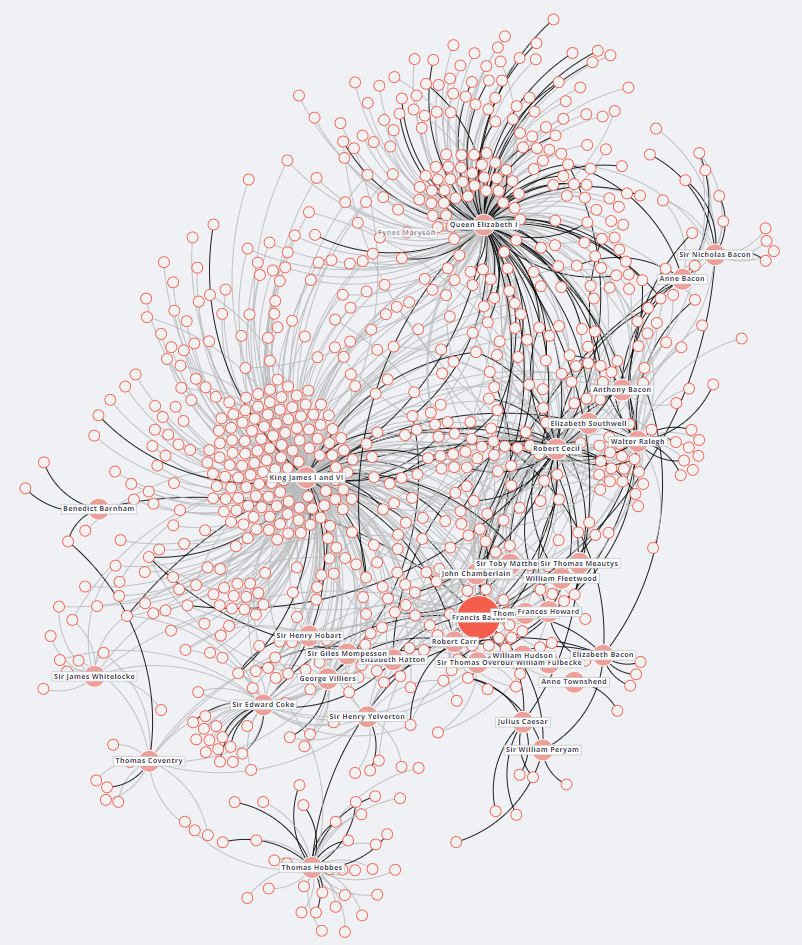
I looked at the Six Degrees of Francis Bacon project, which is a reconstruction of the early modern social network from 1450-1750. In this project, the nodes are different people who lived during this time, and the edges indicate a relationship between two people. The site is not very clear what a “relationship” means, and it states that some relationships are statistically inferred, but if I had to guess it would mean either an in-person interaction or some sort of communication between the two people. The solid nodes indicate a first-degree interaction (the person who’s relationships you’re looking at and the solid node had a relationship), and the white nodes indicate a second-degree interaction (the person who’s relationships you’re looking at and the white node both had a relationship with another person). This project also allows you to search and select different judges, diplomats, royalty, and other people and see who they are connected to. When you select a person, you can see which groups they belonged to. For example, Francis Bacon was a judge, a member of the Virginia company, a member of Gray’s Inn, a philosopher, and more. It is interesting to see the connections between the different people and groups. King James I and VI and Queen Elizabeth have a lot of connections to people, which makes sense given their positions. Another network on this site shows co-membership between groups, so you can see for which pairs of groups it was common for a person to be a member of both, such as the printers and booksellers. In this network, the size of the nodes corresponds to the size of the group and the thickness of the edges corresponds to the amount of people shared between the two groups, which makes it easier to visualize how many people were in each group and how the groups interacted. Overall, this project is really interesting, and I highly recommend you check it out!

I also looked at the Francis Bacon project! I thought it was really interesting as well. In reference to your question about how the project defines a relationship, I think if you click on the edges it says the type of relationship between the two nodes. Most of what I was looking at just said “met”, but some said “Mentor/teacher of”, “patron of”, or some kind of familial relationship.