The project I analyzing is The Rhythm of Food created by Google News Lab & Truth and Beauty.
Link: https://rhythm-of-food.net/#background
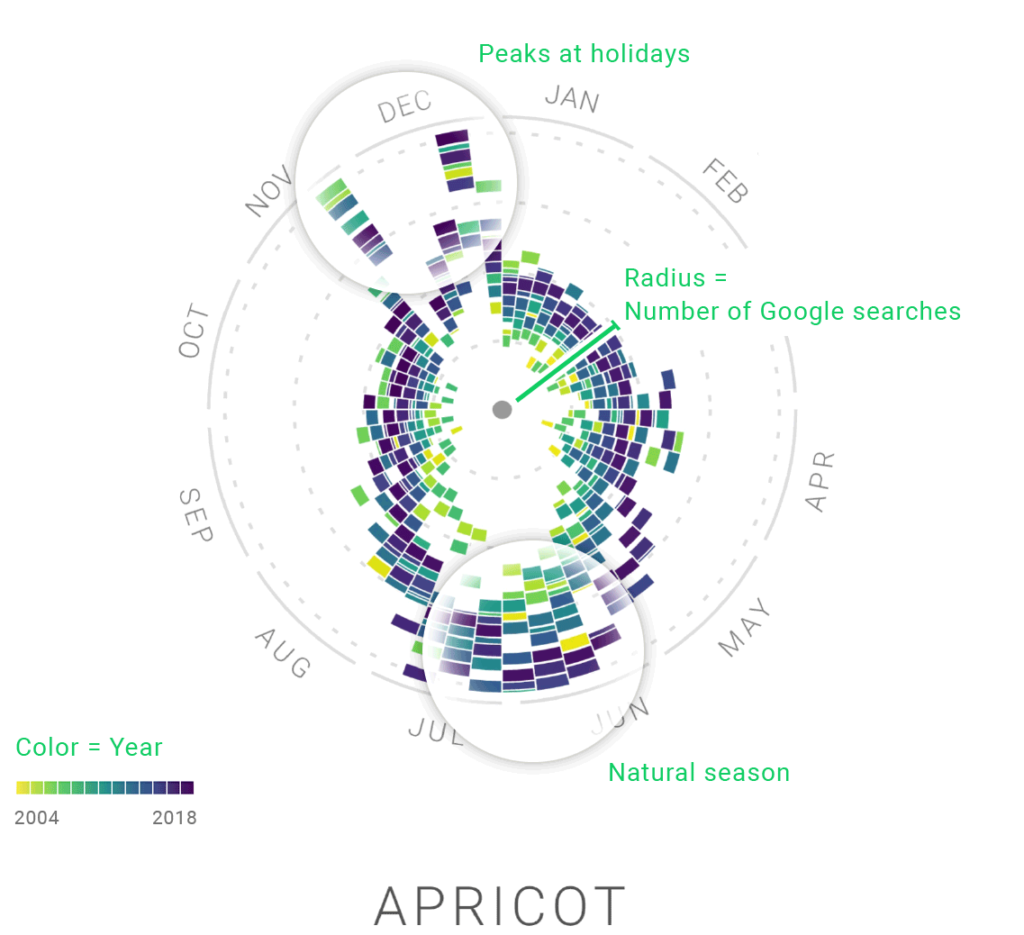
The Rhythm of Food analyzes Google search trends related to food in order to explore recipe, ingredient, and dieting related fads among internet users. For example, the above image visualizes the search popularity of apricots over the last 15 years. You may notice that apricots are most frequently queried during the summer, when they are in season, and around the holidays, perhaps because of their popular use in holiday dishes.
Sources
The data used in creating this digital arts and humanities project was primarily Google trends, which can be freely accessed by anyone who wants to make a similar project. According to the site’s background section, FooDB (a database of ingredients and recipes) provided the jumping-off point for starting the project; it was used to determine the foods that would be compared to Google search trends.
Processes
The amount of data processed for this website is massive. Although Google Trends data is readily accessible and downloadable, I am confident that some amount of software engineering was necessary to scrape and organize the data efficiently, although I can’t glean exactly what. The creators of this project used Google Knowledge Graphs to distinguish between searches for the actual foods (e.g. “apple pie”) and searches with irrelevant relationships to food (e.g. “apple macBook”). It’s unclear exactly how this discerning process works.
Presentation
The data is presented in colorful, visually attractive circle graphs that displays search trends by frequency, time-of-year, and year. The presentation method makes it so none of these aspects of the data are lost on the viewer and can all be understood fluidly together. The software used for creating the display was ES2015, webpack, react, Material UI, and d3 v4.
Questions
One question this project left me with is: do search trends related to food (i.e. the foods people like to look up) reflect the foods people actually eat most frequently? If not, than is this project more of an analysis of food-related internet pop culture rather than food itself?
This site does not pose any argument. Instead, it simply provides information in an unbiased way and leaves it to the viewer to make something out of it, whether it be an argument or not. The primary components of this project are data analysis/processing and interactive presentation of said data.
Overall, I thought this project was accessible, well-organized, and a lot of fun.

I think you pose a great question when you wonder if the searches are related to if people actually eat that food. A great possible follow up study could be done with grocery stores and services like amazon fresh to see the seasonality of food based on when people BUY the food. I think that will give a better idea to if the searches are related to people eating the food.