Between the years of 1935 and 1944, the Farm Security Administration and the Office of War Information commissioned a group of over 40 photographers to take 170,000 pictures of the United States. This colossal collection of photographs has been digitized and uploaded here. The website Photogrammar takes this otherwise incomprehensible amount of data and puts it in a relatively easy to use website for any who chooses to delve into these photographs.
Sources
The sources used for Photogrammar are the numerous photographs taken by the team of photographers between 1935 and 1944 as well as the oral interviews with each of the photographers attached to the website that anyone can listen to. These interviews give the absorber of information more of a context of what was going on during this time. You can literally hear the exact words of the producers of these primary sources which is extremely cool.
This site’s plethora of digital pictures can be used as a source reference for anyone who may need photos of the United States during this time.
Processes
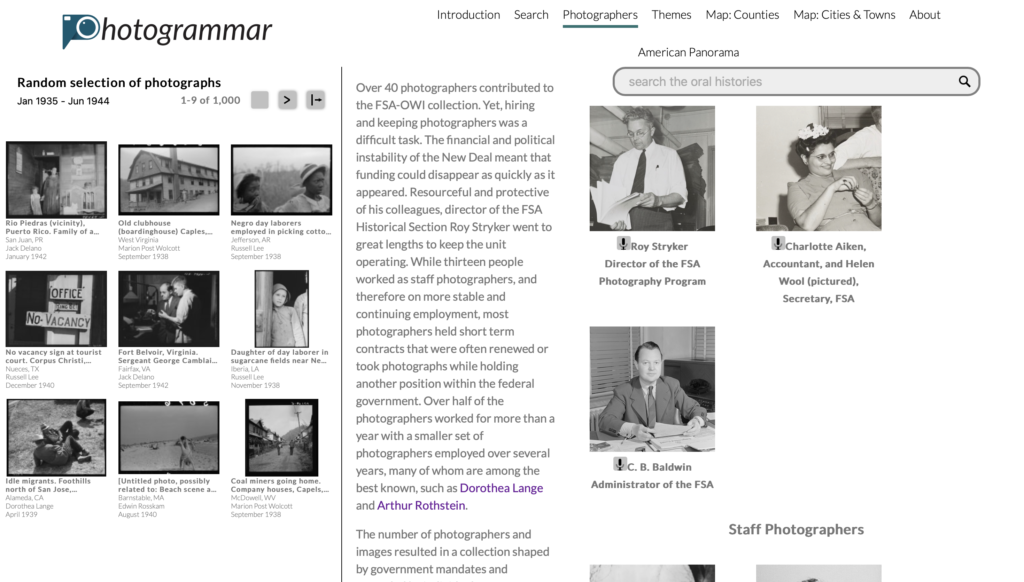
Photogrammar’s processes and services consist of its large database of photographs of America during 1935-1944. Most of the photographs are accompanied by a small description that adds context. While these descriptions may seem like a small addition, they are quite helpful and impressive given the sheer amount of photos on Photogrammar.
In addition to the database of pictures, Photogrammar, as previously mentioned, has recorded interviews with the photographers that can be listened to through the website. The site also has many different headings that can take you to different pages, as well as multiple ways to sort through the photos. You can search for pictures by theme, by state, by county, and so on and so forth.
Photogrammar also allows the user to download the data used throughout the site.
Presentation
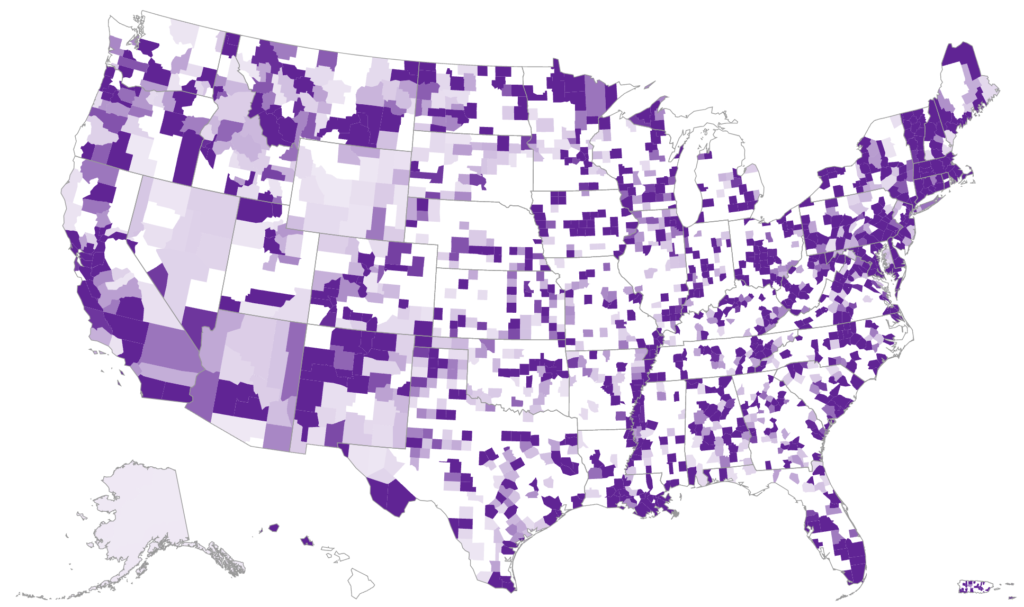
The presentation of the website Photogrammar is quite phenomenal, in my opinion. The website looks fresh and is relatively easy to use. When you first open the site, you are greeted with a bright interactive map of the United States that you can zoom in on. Counties in the United States that have photographs of them can be clicked on and the user can click through all of the pictures taken of that particular county.
If you travel to the ‘Photographers’ tab, you will find the pictures of the photographers and their interviews linked underneath. The whole website is very inviting. It is easy to lose track of time simply going through all of the amazing pictures and listening to the oral interviews with the photographers.
What is the goal?
The goal of Photogrammar, as stated by Photogrammar itself in its ‘About’ section, goes as follows: “Photogrammar provides a web-based visualization platform for exploring the 170,000 photographs taken by the FSA and OWI agencies of the U.S. Federal Government between 1935 and 1943. The project is maintained by the Digital Scholarship Lab (DSL) and Distant Viewing Lab (DV Lab) at the University of Richmond. Lauren Tilton is the director of the project. Taylor Arnold leads the data curation and analysis. Rob Nelson develops and maintains the web-based application. Nathaniel Ayers designed the site and Justin Madronprovided GIS support. Laura Wexler managed the grants. Publications, additional contributors, and major milestones of the project are described in the sections below. The project has been supported by grants from the National Endowment for the Humanities (NEH — any views, findings, conclusions, or recommendations expressed in Photogrammardo not necessarily represent those of the NEH), American Council of Learned Societies (ACLS), and Yale University with ongoing support from the University of Richmond. The FSA-OWI archive is housed at the Library of Congress, which digitized and maintains the collection including details about rights and restrictions.”
Photogrammar utilizes the internet to create one place to house the photographs of the historical project. Without Photogrammar, the only way to see these photos would be in person. That simply is not accessible to most people. Photogrammar represents one of the benefits of digital humanities. Because of sites like Photogrammar, the way photos are accessed and viewed has changed.
Is the project open source/access?
Yes, Photogrammar is open source and open access. Anyone can access the website, and you can download the data they used to make it.
A new question
While I delved through the cornucopia of information that is Photogrammar, I started to wonder how the site was created. It doesn’t seem to have been made through any sort of popular website making software. My guess is that it was coded by actual computer scientists, but I wish they were more clear in how they achieved this fit because the website runs very smoothly which can’t be said for all digital humanities projects.
