The project I explored was, Picturing Michigan’s Past. The project is just as the title says, about Michigan’s past using pictures of postcards.
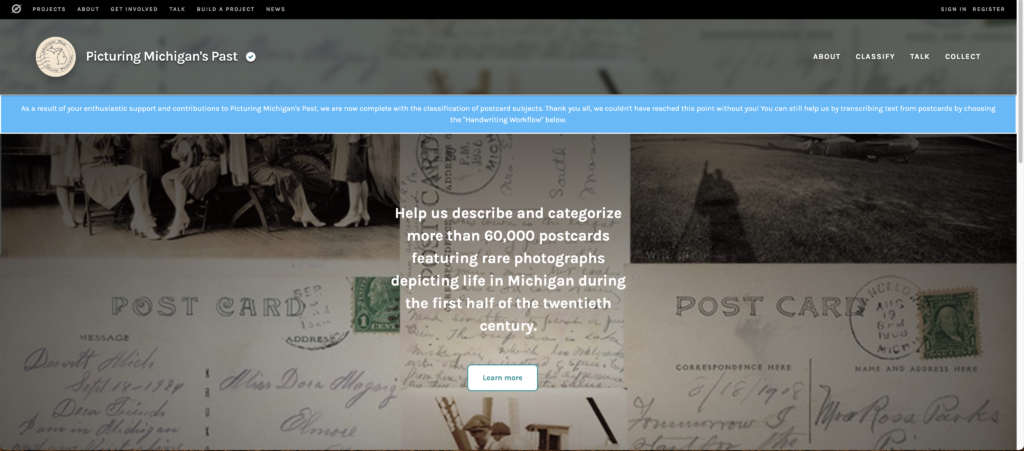
Sources: This project uses over 100,000 images of postcards from David V. Tinder Collection of Michigan Photography at the William L. Clements Library. The majority of these postcards were taken by photographers back in the 1890s to the mid 20th century.
To identify the content and context of each postcard, this project uses crowd-sourcing where anyone can contribute to the project. In the “Classify” section of the website, an image of a postcard is shown with instructions on how the viewer can decipher the image. Data is then collected from the user’s input.
Processes: This project primarily uses crowd-sourcing which can result in complications with the accuracy of the data. To solve this possible issue, the library staff will compile and analyze the data to finalize or fill in any missing information needed. Once the process is done, a new set of unidentified postcards are uploaded to the website for people to transcribe.
Speaking of the website, this research uses Zooniverse, owned by Citizen Science Alliance, which is primarily used for citizen science projects.
Presentation: There is a mix of elements used to present this research.
Data visualization – To show how many people contributed to the transcription of postcards, there is a progress of completion bar (currently 72% of 100,000), and other statistics that come from user interactions with this website.
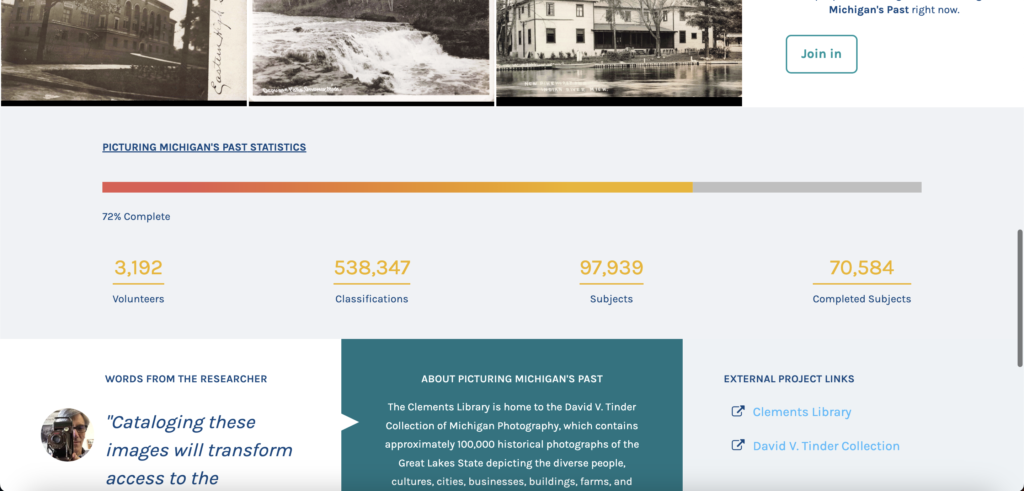
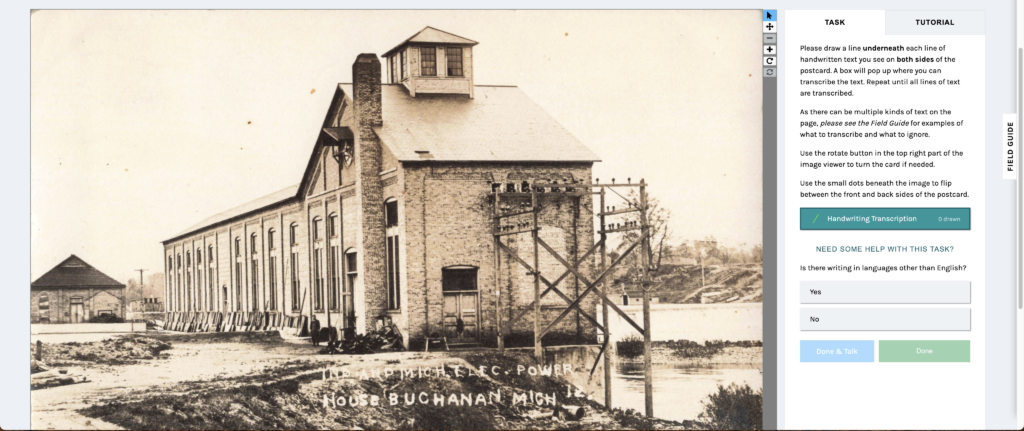
Exhibit – The classify section of the website displays postcards for the viewer to see and analyze. It comes with a set of instructions and tools to magnify or rotate the image. If they are unable to help transcribe a postcard, they have a choice to be given a new postcard.
Digital edition – To give some background context behind the research, there are multiple sections of text for viewers to read and know what kind of research they are getting into.
A question that popped into my head was, will the people orchestrating this research ever consider using AI to help transcribe these postcards? And can AI be used as a resource or process in digital humanities research?
Q. Who is the target audience?
A. The target audience is mainly the general public, researchers, and historians. But it can also be targeted towards people who want to contribute to the restoration of Michigan’s past and families who have ancestors that lived in Michigan and left behind a postcard.
Q. Which academic fields do you see the project in conversation with?
A. I see this project in conversation with history because it works with postcards from over 100 years ago.

Paul, I also find it surprising that Zooniverse would rely on average people to help with this project. It definitely gives a more authentic feel to the project, and probably eases the burden of dedicated humanists. However, the premise of “citizen science” still seems shaky to me; all it could take is one bad apple to spoil the whole bunch via an incorrect transcription.
I think this is a really interesting project! As Tripp said, I’m a bit suspicious of such a level of crowd-sourcing, though I find your idea about artificial intelligence to be interesting. AI is notoriously fallible, so I’d definitely be worried about errors. However, I think with enough human intervention, this could be a really good (and not so dangerous) application of AI!