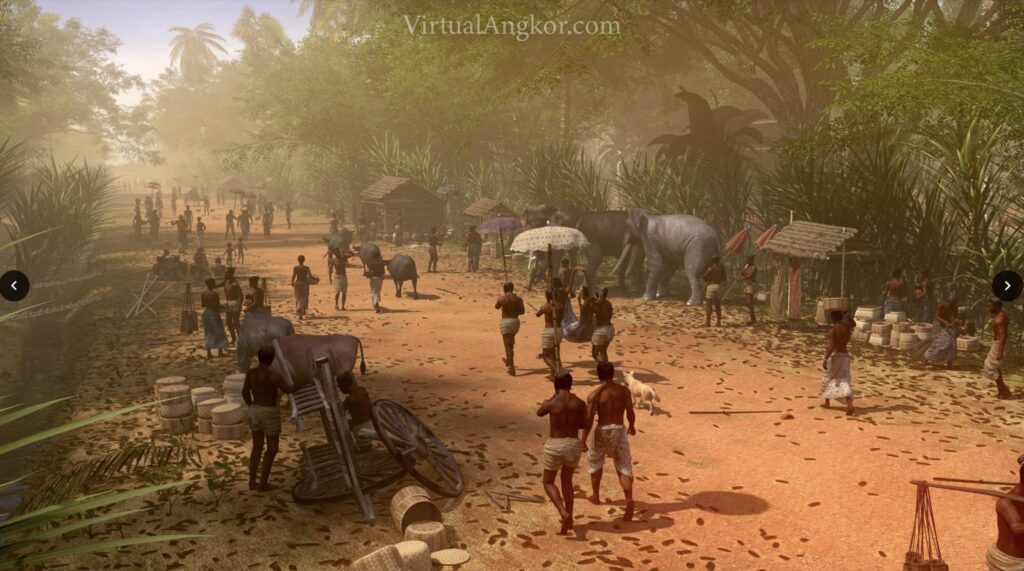
For this assignment I analyzed an immersive 3D model of Angkor, the capital of the Khmer empire in Cambodia around 1300 CE. Viewers can explore different elements of the city in 3D with animated people and processions integrated into the scenery. Since the project’s creation it has evolved from a virtual city to encompass new technologies including an interactive navigable virtual map and VR experience.
Sources
In order to create the virtual city, archeologists, historians and virtual history specialists across Australia, Cambodia and the US scanned a collection of Angkorian bronze statues and status items in museums and galleries across the world. In conjunction with old Khmer and Sanskrit inscriptions describing the political, economic and social life of Angkor and French accounts of 19th century, Cambodian historians were able to model an elephant and the anatomy of the people of Angkor. For the creation of roads, canals, rice fields and wooden dwellings, the project managers turned to archeological mapping conducted by the University of Sydney.
Process
3D models of buildings, people, artifacts and animals were imported into Unity. The project’s interactive virtual map also implemented LiDA data, digital elevation files and GIS mapping layers.
Presentation
The finished product is a website containing several different features. The first is an educational series that includes teaching modules about Angkorian kingship and power, intricate water management systems developed in Angkor and Angkorian trade networks across east and southeast Asia. The main attraction is a series of videos that allow the user to move in 360 through Angkor’s city sites.
Target Audience
This project is targeted at all backgrounds through the exploratory nature of VR and 3D models. However, it is also a great resource for historians of medieval societies and Angkor specifically.
Questions
After breaking down the project into its sources, process and presentation I’m curious how much time each part of the process took as well as how many people it took to work on each part of the process. The project as a whole still seems very complicated after breaking it down, as it is ongoing and multidimensional. I wonder if there are other places around the world that have developed similar models? How do the strategies for reconstructing each site differ? How are they similar?
