The digital world and the humanities have long been viewed as two very different and separate entities. However, with the pervasiveness of the digital world, many humanists have made the argument that students of the humanities should learn how to code. The two readings for this week presented both sides of the argument on whether humanities students should learn to code. Matthew G. Kirschenbaum, an English professor, argues that humanities students SHOULD learn to code while Evan Donahue, a student of the computer sciences, argues that humanities students should NOT learn to code. I agree with Matthew G. Kirschenbaum on this one. Humanities students should learn to code.
Computers should not be black boxes but rather understood as engines for creating powerful and persuasive models of the world around us.
Matthew G. Kirschenbaum “Hello Worlds (why humanities students should learn to program)”
This quote from Matthew G. Kirschenbaum’s argumentative piece on how humanities students should learn to code really represents his point, in my opinion. The concept of computers should not be regulated only to students of the computer sciences. Computers, and the digital world as a whole, have a place in every field of study. In this day an age, it the Digital is inescapable and I feel there is no use in treating as something that is. Humanists work to define the world around us, and learning to code would only make that task easier as well as more presentable to a greater amount of people. Printing something in a book is accessible, but posting the same information in some digital way is even more accessible.
My experience coding
Prior to this lab, I had next to no experience with coding. I had done various small assignments in elementary school media labs for the “Hour of Code,” but it was nothing compared to what I had to do for this lab.
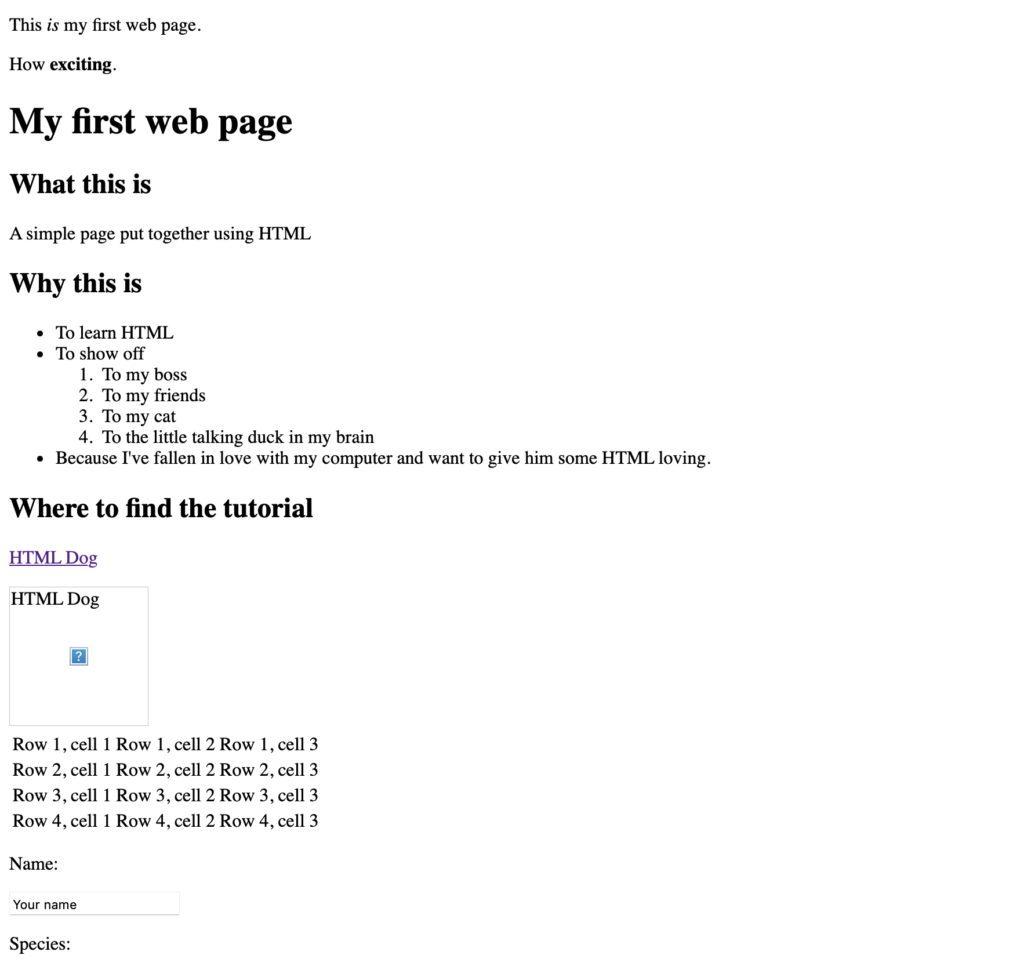
For this lab, I chose to complete the beginning tutorials for HTML and CSS on HTML Dog. HTML seemed a practical choice given its role as a base level program on a website. The structure of a website is HTML. After some minor hiccups with the TextEdit feature on my Mac that Dr. Saladin so kindly helped me with, HTML was relatively easy to get a hang of. It was very cool to see the site I was coding in real time. After each new step, I would reload my webpage and see the changes I had just coded into it. That feeling of creating something even though I barely had any computer science experience was unparalleled. It showed me that the world of coding is not as scary as it may seem at first. It is a lot more accessible than I had once thought. The trickiest part of HTML for me to learn was the table making part. I wasn’t able to get it to show up as a table instead of words on my webpage. I tinkered with the code and spaces trying to make it work, but I’m not sure what I was doing wrong.
My tutorial on CSS did not go as smoothly as my HTML tutorial went. I had trouble connecting my CSS project to my HTML project. I think (not 100% sure) that CSS needs something like an HTML base to even work. CSS edits the presentation of what HTML built. I liked CSS a lot because I like being able to control what my webpage looks like. Changing the colors of things was fun and cute.
Coding example
While working on the HTML tutorial, I felt the HTML list tool would be very helpful for a humanities student to learn because the humanities, especially history, is all about lists.
<!DOCTYPE html>
<html>
<head>
<title>Queen Elizabeth II</title>
</head>
<body>
<h1>Queen Elizabeth II's Personal Life</h1>
<h2>Queen Elizabeth II's Children</h2>
<ul>
<li>King Charles III</li>
<li>Anne, Princess Royal</li>
<li>Prince Andrew, Duke of York</li>
<li>Prince Edward, Duke of Edinburgh</li>
</ul>
</body>
</html>
The example code above, if put into a text editor like TextEdit, would create a webpage about Queen Elizabeth II and list out her children. I chose this example because I feel like it connects to the humanities and proves that humanists knowing how to code is a good thing.
Summary
In summary, I’ve found coding to be an extremely useful skill for humanities students to pick up in the 21st century. As a prospective humanities major myself, the coding I learned this week has already broadened my horizons with what I can do in my chosen field. It is always good to simply know more. Coding is not computer science specific, and it can be used across many disciplines. I’m not saying all humanities students need to become coding experts, but a little knowledge about it would only benefit them.
3 thoughts on “Lab 2- Web Development Basics (Max Votruba)”
Great lab assignment submission! I agree with your viewpoint, and your work throughout the page seems very well put together! Not to mention the sections, headings, and breaks during the post! It is a lovely touch to the submission. Coding in the humanities can be a handy tool for many students, as shown in this post!
Great lab, and a really cool website to use as an example! Your lab is well formatted, and it’s always interesting to hear about people’s experiences learning programming languages, especially when they’re just starting out. Do you think you’ll use it for your humanities work in the future? Or is it more for just understanding the perspective?
I can definitely relate to your experience with coding but, mine starting my sophomore year of high school. The HTML tutorial seemed rather easy to follow with all the straightforward instructions while the CSS tutorial was harder to grasp and apply; nevertheless, great work with the HTML and CSS considering the lack of experience you described in your post.

Great lab assignment submission! I agree with your viewpoint, and your work throughout the page seems very well put together! Not to mention the sections, headings, and breaks during the post! It is a lovely touch to the submission. Coding in the humanities can be a handy tool for many students, as shown in this post!
Great lab, and a really cool website to use as an example! Your lab is well formatted, and it’s always interesting to hear about people’s experiences learning programming languages, especially when they’re just starting out. Do you think you’ll use it for your humanities work in the future? Or is it more for just understanding the perspective?
I can definitely relate to your experience with coding but, mine starting my sophomore year of high school. The HTML tutorial seemed rather easy to follow with all the straightforward instructions while the CSS tutorial was harder to grasp and apply; nevertheless, great work with the HTML and CSS considering the lack of experience you described in your post.