All of the digital network projects were very insightful, but the one that resonated with me the most was the Six Degrees of Francis Bacon project. This one examines the social connections of Francis Bacon, a politician and philosopher, who according to this website, knew a lot of other powerful and notable people in the Anglosphere.
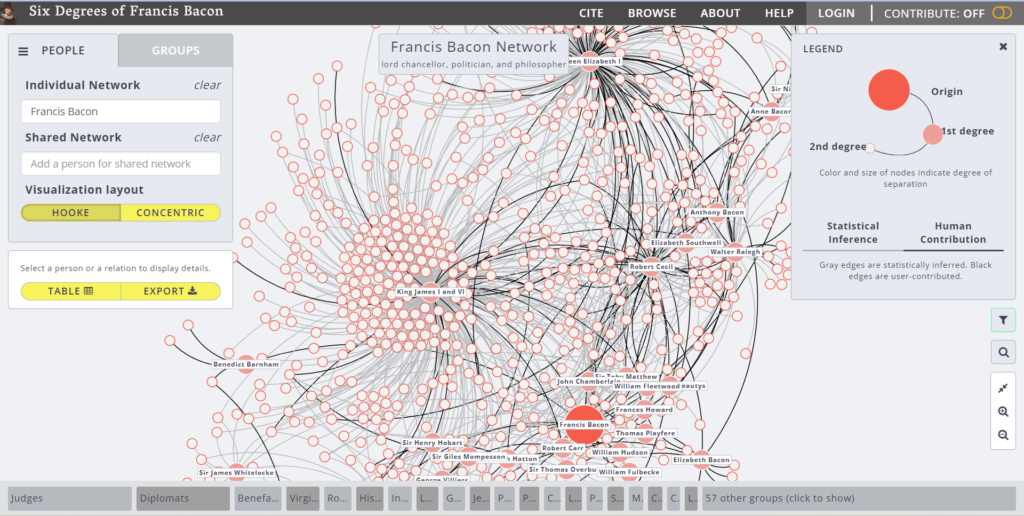
In this project, the nodes are the people Bacon knew (including Bacon himself), and the edges are the connections between Bacon and someone else he knew. The project doesn’t just tell us about the fact that he knew people, it also dives into the type of people he knew. On the bottom of the page, you can see an option to filter by profession (judge, diplomat, etc.).
There are two main ways to see the social network; hooke or cocentric. Personally, I found the hooke format to be more visually appealing, as the cocentric model had a lot of webpage lag associated with it, although I see the usefulness is categorizing networks by 1st and 2nd degree.
One useful interaction that the program allows is for the user to highlight other noblemen’s social network, which consist of their first and second connections. This dramatically reduces the clutter of names that appears on the screen by default (Francis Bacon was that popular).
To create this program, a team of academics used a combination of coding languages Python and JavaScript to code the website. The data was sourced from many libraries and databases in universities worldwide, but especially the Shakespeare Library Digital Collection. The code is open source, which is something of a pattern I have been noticing on digital humanities projects. Overall, while the website does suffer from clutter, especially on the starter page, it is a very solid resource and once you learn how to navigate to more limited networks, it becomes a much more valuable tool.

This project is very interesting to me mostly because it shows how people do not interact with other outside of their class at this time. There is a very specific type of person Bacon interacts with (judge, diplomat). It is possible, though, that this could be biased based on the kind of records that were preserved recording his interactions.