“Such an education is essential if we are to cultivate critically informed citizens — not just because computers offer new worlds to explore, but because they offer endless vistas in which to see our own world reflected.”
Kirschenbaum, Matthew. Matthew G. Kirschenbaum, May 2010, https://mkirschenbaum.wordpress.com/2010/05/23/hello-worlds/. Accessed Sept. 2023.
Both the humanities and computer science deal with preconceived ideas about what each discipline studies and is used for, meaning the similarities and collaborative uses of both are often ignored or misunderstood. The way I see it, computer science and the humanities are inextricably linked; the humanities study human society and culture, which in the modern age, greatly involves the digital world and computer sciences. Inversely, a great deal of computer science is dedicated to improving and representing human society and culture, which falls under the umbrella of the humanities.
Essentially, both the humanities and computer sciences are tools and practices, with each as a practice being improved by using the other as a tool.
So, when it comes to the question of whether humanities students should learn to code, as a statement encouraging collaboration between coding and humanistic study I agree. Beyond the tagline, the idea is obviously more nuanced. I don’t think coding should be a requirement for humanities students, just like how learning about ancient Carthage or Incan rituals aren’t requirements. My view is that, like those other subjects, coding should be more encouraged in academia as an available area of humanistic study.
I have had some prior experience with coding, but very limited. When I was a kid I used to mess around with the “inspect element” option on Google, changing words, font sizes, and colors. My brother and I were also very into making Scratch games and using HTML on Windows to make the computer speak.
However, I have little to no formal teaching or experience with coding, so I chose to do the HTML and CSS beginner tutorials on HTML dog, which I greatly enjoyed:
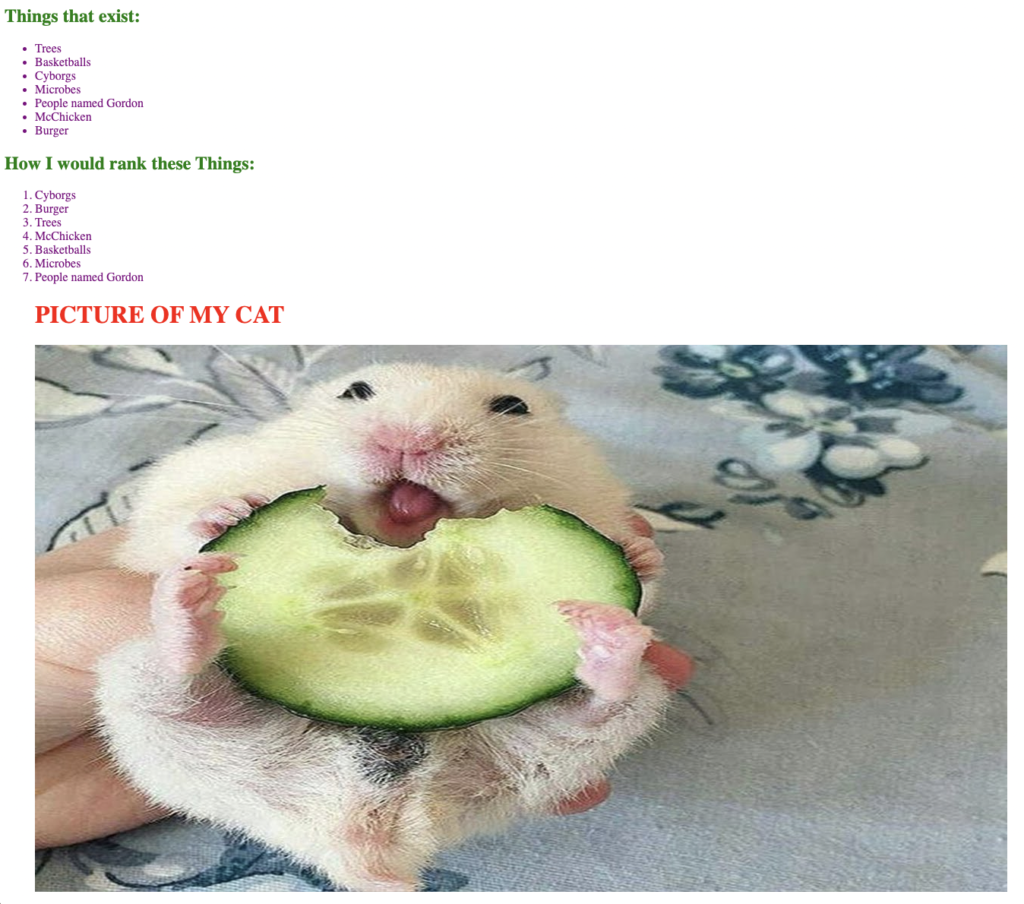
The tutorials went well and were easy to follow for the most part. The most trouble I had was getting TextEdit to work right; if you want it to function for use like the tutorial, you need to go to format and select Plain Text.
Because I didn’t get into JavaScript, it’s tempting for me to say what I learned doesn’t have an extensive application supporting humanities students learning to code. However, as a person who has always been more interested in the humanities rather than STEM, I greatly enjoyed these tutorials and have always also been very interested in coding, which can sort of serve as an argument on its own. However, basic HTML and CSS are enough for a basic web display, which can be used for the humanities in the same way a presentation or poster can. For instance, if I wanted to briefly introduce a topic with description, images, and links, I could do all that with HTML in TextEdit:
<!DOCTYPE html>
<head>
<title> Exploration: Vostok I and Ideology</title>
</head>

<body>

<h1>Vostok I: Russian Communism and Nationalism's effects on Space Exploration</h2>

<h2>The Cold War and Space Race</h2>
<p>relevant information here!</p>

<h2>Communism versus Capitalism</h2>
<p>relevant information here!</p>

<img src="vostokspace.jpg" alt="Picture of Vostok I">

<h2>Sources</h2>
<ul>
<li><a href="https://www.firstreference.com/">Source One</a>
<li><a href="http://www.secondreference.com">Source Two</a>
<li><a href="http://www.thirdreference.com">Source Three</a>

</body>
</html>
Which is one example of using simple HTML to present a humanities topic by digital means!

Hello Adiana!
I enjoyed reading your response to the current debate. I had a similar response in such that I don’t think humanities students should be required to take programming classes. If these students have an interest in partaking in both Computer Science and the humanities, they should. But, it should not be forced on all humanities students. I liked how you talked about the strong connection between humanities and computer science and how that overlap can be useful for our future.
Hi! I really agree with the last point you made– I feel like HTML and CSS are great tools for humanities students to present information, just like a presentation or poster. Of course, there are many platforms to create websites without needing HTML/CSS knowledge that these students could use, but being able to do it yourself with HTML/CSS definitely gives people more options.